How T. rex was discovered
A tooth nobody recognised, a backbone given the wrong name, and a skeleton dug out of Montana by a man nicknamed Mr. Bones.
Mr. Bones
Barnum Brown (1873–1963) was nicknamed “Mr. Bones”. Wikipedia: Barnum Brown Barnum Brown, of the American Museum of Natural History, found a partial skeleton in Montana’s Hell Creek Formation in 1902. That skeleton became the type specimen of T. rex. Wikipedia: Tyrannosaurus
Brown wrote at the time: “I have never seen anything like it from the Cretaceous.” Wikipedia: Tyrannosaurus
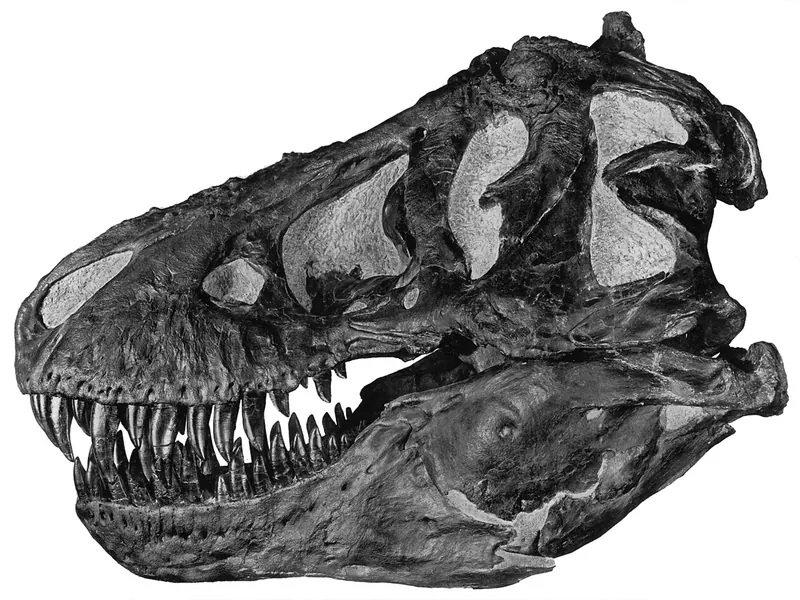
Named in 1905
Tyrannosaurus rex was named in 1905 by Henry Fairfield Osborn, president of the American Museum of Natural History. Wikipedia: Tyrannosaurus The name means “tyrant lizard king”: tyrannos is Greek for tyrant, sauros is Greek for lizard, and rex is Latin for king. Wikipedia: Tyrannosaurus
In the same 1905 paper Osborn named Brown’s Wyoming skeleton Dynamosaurus imperiosus. In 1906 he realised both were the same species. Wikipedia: Tyrannosaurus T. rex won because its name appeared one page earlier than Dynamosaurus in Osborn’s 1905 paper. If the pages had been the other way round, it would be called Dynamosaurus. Wikipedia: Specimens of Tyrannosaurus
Osborn also named Velociraptor. Wikipedia: Henry Fairfield Osborn
The name that came too early
In 1892 Edward Drinker Cope found two pieces of backbone and named them Manospondylus gigas, “giant porous vertebra”. They are now thought to be from a T. rex, but the name T. rex stuck. Wikipedia: Tyrannosaurus
From Allosaurus arms to a level back
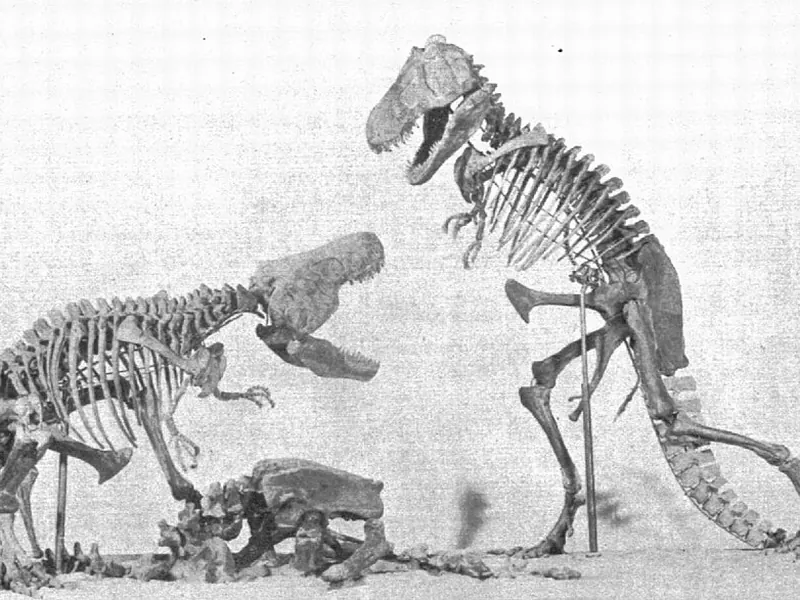
For the first mounted skeleton in 1915, Osborn gave T. rex longer, three-fingered arms like those of Allosaurus, because the hands had not been found. Wikipedia: Tyrannosaurus The first complete T. rex skeleton went on show in 1915 in that upright pose, and stood that way for 77 years until it was taken down in 1992. Wikipedia: Tyrannosaurus
By 1970 scientists realised the pose was wrong: a living animal standing like that would have dislocated its joints. Wikipedia: Tyrannosaurus Today T. rex is shown with its body roughly level with the ground and its tail held out behind to balance the head. Wikipedia: Tyrannosaurus
Moving house
In 1941 the type specimen was sold to the Carnegie Museum of Natural History in Pittsburgh, partly to protect it from possible bombing raids during the Second World War. Wikipedia: Specimens of Tyrannosaurus The original Dynamosaurus bones are now in the Natural History Museum, London. Wikipedia: Tyrannosaurus
From the 1910s to the end of the 1950s, Barnum Brown’s finds were the only T. rex specimens known, as the Great Depression and wars kept many palaeontologists out of the field. Wikipedia: Tyrannosaurus
Painting a monster
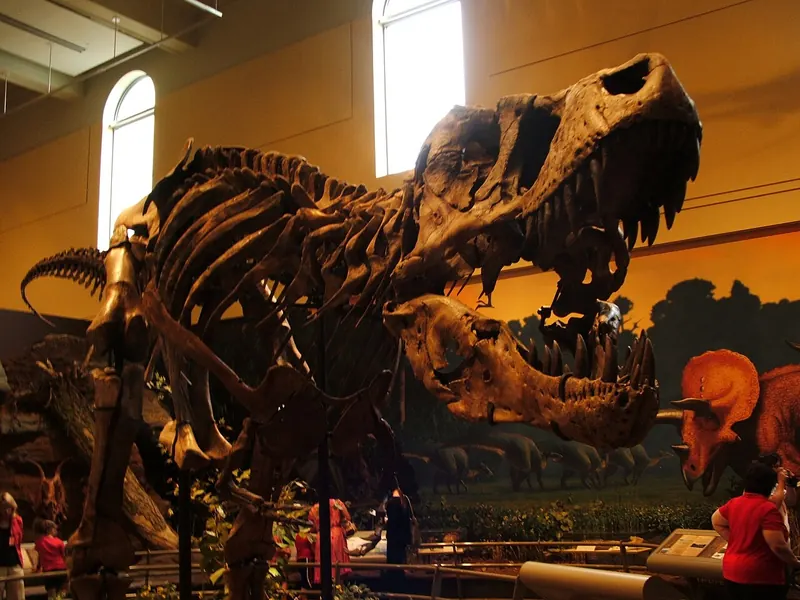
Charles R. Knight (1874–1953) painted dinosaurs for museums. His mural of Tyrannosaurus and Triceratops helped make the two “mortal enemies” in popular culture. Wikipedia: Charles R. Knight Because many fossils were fragmentary in his day, many of Knight’s paintings are now known to be wrong in places. Wikipedia: Charles R. Knight
Timeline
- 1874 A tooth now known to be from a T. rex was found in July 1874 near Golden, Colorado. Wikipedia: Tyrannosaurus
- 1892 In 1892 Edward Drinker Cope found two pieces of backbone and named them Manospondylus gigas, “giant porous vertebra”. They are now thought to be from a T. rex, but the name T. rex stuck. Wikipedia: Tyrannosaurus
- 1900 Brown had already found a first partial skeleton in eastern Wyoming in 1900. Wikipedia: Tyrannosaurus
- 1902 Barnum Brown, of the American Museum of Natural History, found a partial skeleton in Montana’s Hell Creek Formation in 1902. That skeleton became the type specimen of T. rex. Wikipedia: Tyrannosaurus
- 1905 Tyrannosaurus rex was named in 1905 by Henry Fairfield Osborn, president of the American Museum of Natural History. Wikipedia: Tyrannosaurus
- 1906 In the same 1905 paper Osborn named Brown’s Wyoming skeleton Dynamosaurus imperiosus. In 1906 he realised both were the same species. Wikipedia: Tyrannosaurus
- 1915 The first complete T. rex skeleton went on show in 1915 in that upright pose, and stood that way for 77 years until it was taken down in 1992. Wikipedia: Tyrannosaurus
- 1941 In 1941 the type specimen was sold to the Carnegie Museum of Natural History in Pittsburgh, partly to protect it from possible bombing raids during the Second World War. Wikipedia: Specimens of Tyrannosaurus
- 1989 The first complete T. rex arms were not identified until 1989, from a specimen called the Wankel rex. Wikipedia: Tyrannosaurus
- 1990 Sue was found on 12 August 1990 by fossil hunter Sue Hendrickson, and is named after her. Wikipedia: Sue (dinosaur)
- 1998 In 1998, 20-year-old Bucky Derflinger spotted a T. rex toe bone sticking out of the ground: the youngest person to discover a Tyrannosaurus. Bucky was the first T. rex found with a wishbone. Wikipedia: Tyrannosaurus
- 2005 In 2005 Mary Higby Schweitzer and colleagues reported flexible, blood-vessel-like structures inside a T. rex leg bone. What they are is still argued about. Wikipedia: Tyrannosaurus · checked 24 Oct 2026
- 2026 In July 2026, scientists described a foot bone from a hatchling T. rex, estimated at about 75 cm long and 2.5 kg. Wikipedia: Tyrannosaurus · checked 24 Oct 2026
Next: famous fossils →