Skull, teeth and tiny arms
A huge head on a short, strong neck, balanced by a long, heavy tail, all walking on two very long legs. And then there are the arms.
Built like a seesaw
T. rex was a theropod: a two-legged meat-eater, with a massive skull balanced by a long, heavy tail. Wikipedia: Tyrannosaurus The heavy tail balanced the huge head and body, and held big muscles that powered the legs. Wikipedia: Tyrannosaurus
Its neck was short, deep and muscular, to hold up that enormous head. Wikipedia: Tyrannosaurus Many of its bones were hollow, which saved weight without losing much strength. Wikipedia: Tyrannosaurus
For its body size, T. rex had some of the longest legs of any theropod. Wikipedia: Tyrannosaurus
The skull
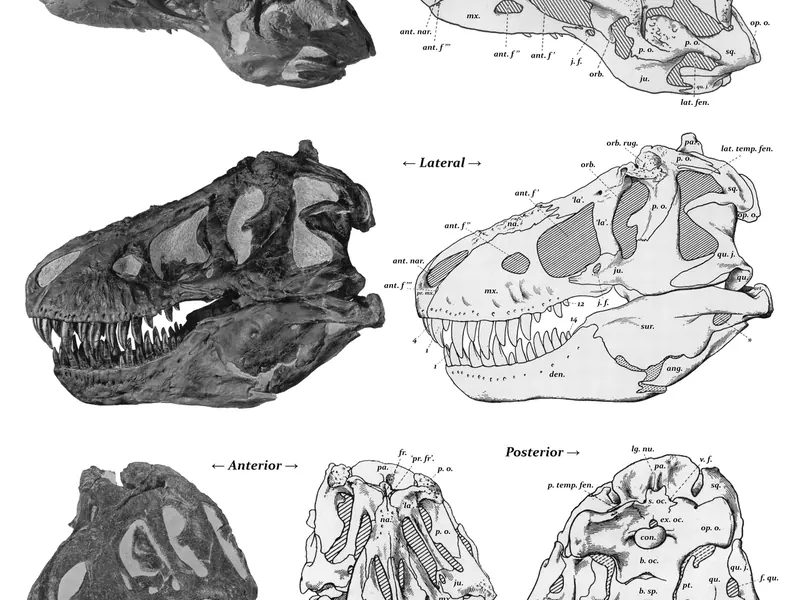
The largest known T. rex skulls are up to 1.52 m long. Wikipedia: Tyrannosaurus · checked 24 Oct 2026 Big openings in the skull cut down its weight, and many skull bones were filled with tiny air spaces. Wikipedia: Tyrannosaurus
The skull was very wide at the back but had a narrow snout, which gave T. rex unusually good binocular (forward-facing) vision. Wikipedia: Tyrannosaurus The tip of the upper jaw was U-shaped, not V-shaped as in most other big meat-eaters, so each bite took out more flesh. Wikipedia: Tyrannosaurus
The teeth
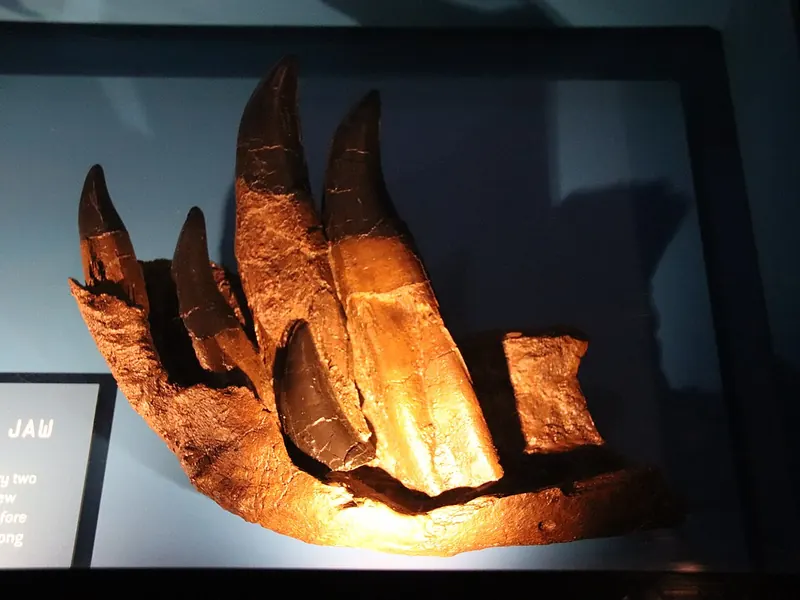
Most of its teeth were thick and robust, more like “lethal bananas” than daggers. Wikipedia: Tyrannosaurus The four front teeth on each side of the upper jaw were D-shaped in cross-section, which helped stop them snapping when T. rex bit and pulled. Wikipedia: Tyrannosaurus
The largest T. rex tooth found so far is estimated to have been 30.5 cm long, root included: the largest tooth of any meat-eating dinosaur yet found. Wikipedia: Tyrannosaurus · checked 24 Oct 2026 Like other theropods, T. rex replaced its teeth throughout its life. Wikipedia: Tyrannosaurus
Lips or no lips?
Scientists still debate whether T. rex had lips. A 2023 study argued that theropods like it probably did, which would have kept their teeth covered and wet. Wikipedia: Tyrannosaurus · checked 24 Oct 2026
That bite
A 2012 study by Karl Bates and Peter Falkingham estimated that an adult T. rex could bite with 35,000 to 57,000 newtons of force at the back teeth, the most powerful bite of any land animal that has ever lived. Other studies give different figures. Wikipedia: Tyrannosaurus · checked 24 Oct 2026 Its bite could crush bone. Wikipedia: Tyrannosaurus
One study calculated that T. rex could open its jaws to an angle of around 80 degrees. Wikipedia: Tyrannosaurus · checked 24 Oct 2026 It probably tore up food with sideways shakes of the head, like a crocodile. Wikipedia: Tyrannosaurus
The famous arms
T. rex arms were only about 1 metre long, and each hand had two clawed fingers. Wikipedia: Tyrannosaurus Small, but strong: the bones show large areas where muscles attached. Wikipedia: Tyrannosaurus
The biceps muscle of an adult T. rex could lift an estimated 199 kg on its own, 3.5 times more powerful than a human’s. Wikipedia: Tyrannosaurus · checked 24 Oct 2026
Nobody knows for sure what the arms were for. Ideas include gripping a mate, helping it get up off the ground, and holding struggling prey. Wikipedia: Tyrannosaurus A 2022 paper by Kevin Padian suggested the arms got smaller so they would not be bitten off by other tyrannosaurs during group feeding. Wikipedia: Tyrannosaurus · checked 24 Oct 2026
For the first mounted skeleton in 1915, Osborn gave T. rex longer, three-fingered arms like those of Allosaurus, because the hands had not been found. Wikipedia: Tyrannosaurus The first complete T. rex arms were not identified until 1989, from a specimen called the Wankel rex. Wikipedia: Tyrannosaurus
Scales, feathers, or both?
Skin impressions from a T. rex nicknamed Wyrex show patches of small scales on the tail, hip and neck. Wikipedia: Tyrannosaurus A 2017 study concluded that if big tyrannosaurids like T. rex had feathers at all, they were limited to the top of the back. Wikipedia: Tyrannosaurus · checked 24 Oct 2026
Dilong, a small early relative found in China, was the first tyrannosaur found with evidence of feathers. Wikipedia: Dilong paradoxus Yutyrannus, a large feathered tyrannosaur relative, was named in 2012. Its fossils are the largest known dinosaur specimens with direct evidence of feathers. Wikipedia: Yutyrannus · checked 24 Oct 2026
Bird bits
T. rex had a wishbone (furcula), as birds do. Wikipedia: Tyrannosaurus Its belly was protected by 18 or 19 pairs of belly ribs. Wikipedia: Tyrannosaurus
Birds are the only living dinosaurs. They evolved from earlier theropods, the same big group T. rex belongs to. Wikipedia: Bird
Warm-blooded?
A study of chemical isotopes estimated T. rex’s body temperature at about 36 °C, which suggests it was warm-blooded. Not every scientist agrees. Wikipedia: Tyrannosaurus · checked 24 Oct 2026
Sizes, masses, speeds and bite forces for T. rex are estimates from fossils, and different studies get different answers. Where we give a figure, the source link says which study and the date we checked it.
Next: how it lived →